
AI News Roundup: Kimi K3, LPDDR6 and China's DUV Push
AI news roundup for 28 July 2026: Kimi K3 tops DesignArena, OpenAI resets Codex limits, SK hynix begins LPDDR6 output and China starts domestic DUV tools.
Some days the AI news is one big story. Tuesday 28 July 2026 was eight smaller ones — and read together they say more than any of them alone.
This AI news roundup covers the past day: an open-weight model winning a design benchmark outright, an Anthropic researcher breaking with company policy in public, a self-improvement framework from Alibaba’s Qwen, a departure at Thinking Machines Lab, and three semiconductor stories that describe one supply chain being quietly rebuilt. For each item — what happened, and what it changes.
Kimi K3 tops the DesignArena slides benchmark at 1379 Elo
Kimi K3, the open-weight model from Moonshot AI, has taken first place on the DesignArena Slides Arena — a benchmark measuring how well a model converts a natural-language prompt into a complete, production-ready PowerPoint presentation using the python-pptx library. Its 1379 Elo rating is the largest performance margin recorded on that leaderboard to date, ahead of leading proprietary systems including Claude variants.
The task is harder than it sounds. Building a usable deck is long-horizon and multi-step: the model must plan structure, hold a layout across many slides, emit valid library code, and keep the output visually coherent. It is closer to agentic work than to chat.
Why this matters
Open-weight models have been closing the gap on reasoning benchmarks for a while. Winning a structured generation task outright is a different signal — it says an open-weight model can be trusted with the document work enterprises actually pay for, entirely inside your own perimeter.
An Anthropic researcher breaks ranks on open weights
An Anthropic research engineer has publicly voiced disagreement with the company’s formal position on open-weight models, expressing gratitude to colleagues who have advocated internally for greater openness. The statement drew significant attention across the AI research community.
Read it as a signal rather than a scandal. Frontier laboratories are not monolithic, and the balance between safety controls and open collaboration is argued inside them as vigorously as outside. The competitive pressure is real: when open-weight releases win benchmarks outright — as the first item here shows — holding weights back gets harder to justify internally.
For organisations in this region the debate has a practical edge. Sovereignty requirements, Arabic-language performance and data residency all point towards models you can host yourself — much of the reasoning behind Yehia, our Arabic-first LLM.
OpenAI resets usage limits for Codex and ChatGPT Work
OpenAI has restored full usage quotas for all paid Codex and ChatGPT Work subscribers, following the periodic limit adjustments made earlier in the cycle. Developers and enterprise users regain high-capacity access to advanced coding assistance and productivity features.
A small item with a real implication: capacity is now a product lever. Agentic coding burns tokens at a rate conversational use never did, so quota policy is effectively the rationing of compute — and it moves with supply.
Treat a reset as a window, not a settled state, and design workflows that degrade gracefully when limits tighten again.
Qwen’s Skill Self-Play turns skill libraries into training infrastructure
Alibaba’s Qwen research team has released Skill Self-Play, a framework that lets large language models improve through co-evolving skill libraries. Rather than relying on uncontrolled self-generated data, it maintains a growing collection of verified task templates that guide the model on what to practise, how to construct high-quality training tasks, and how to validate outcomes.
That last element is the interesting part. Autonomous improvement loops usually fail because the model grades its own homework and drifts. A curated, verified library is a structural check on that drift — and it promotes skill libraries from inference-time convenience to first-class training infrastructure.
The same logic holds downstream. Enterprise systems that ground a model in governed, verified knowledge — the approach behind Bayan, our RAG platform — work for precisely the reason Skill Self-Play does: the source of truth is curated, not generated.
Lilian Weng departs Thinking Machines Lab
Lilian Weng, co-founder of Thinking Machines Lab and previously a senior leader in AI safety and robotics research at OpenAI, has announced her departure after roughly seven months, with recurring health challenges making frontier-laboratory schedules unsustainable. In her message to colleagues she underscored a guiding principle: the future worth building remains fundamentally human-centred.
A notable leadership change at one of the newer high-profile research organisations — and a reminder of the operating cost of this cycle. Talent sits thinly enough at the top of the field that a single departure can move an institution’s direction.
The semiconductor picture: three stories, one direction
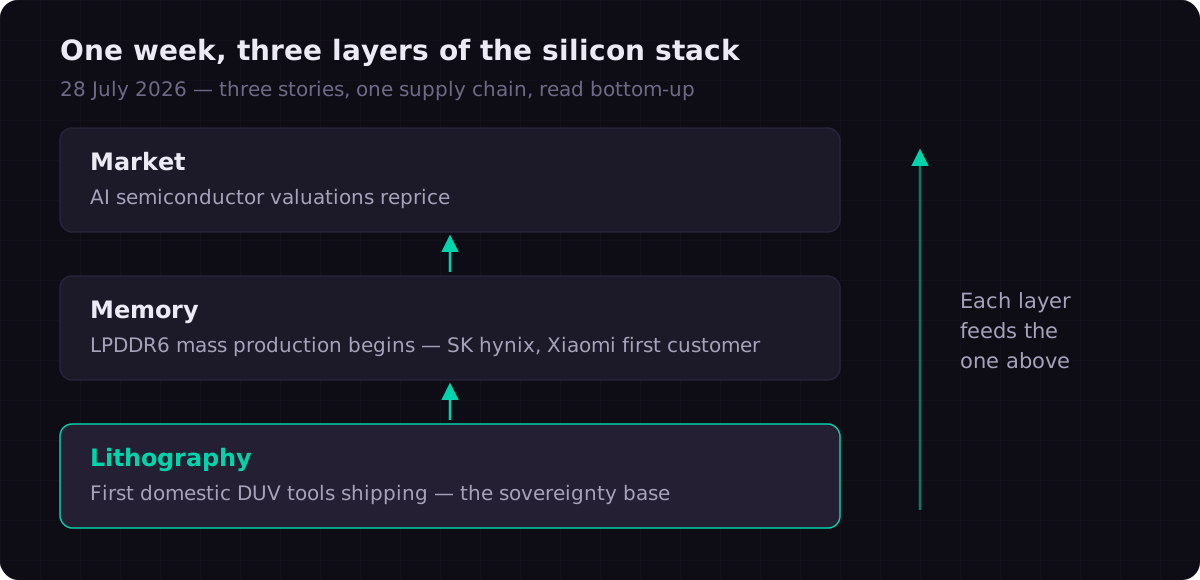
The remaining three items are best read together. Equity markets are re-rating AI hardware, memory vendors are racing into a new form factor, and China has started building its own lithography tools. One underlying question: who controls the supply of AI compute, and at what price.
AI semiconductor stocks reprice on sentiment, not fundamentals
The fundamentals were strong — roughly 80% growth at Google Cloud Platform, a significant beat from Intel, and upward revisions to CapEx and order outlooks from ASML, TSMC and Intel. AI hardware equities entered a corrective phase regardless.
Attention has pivoted from CapEx growth to harder questions: return on investment, the durability of GPU pricing power, rising financing costs, and the timeline to sustained profitability among major AI developers. Even long-term bulls are now focused on downside risk.
Analysts point to a specific unlock — clear validation of next-generation productivity applications, particularly agentic systems that meaningfully automate parts of software development. Until that arrives, infrastructure spending reads as a cost centre rather than a productivity investment. This is market observation, not investment advice.
SK hynix begins LPDDR6 mass production with Xiaomi as lead customer
SK hynix will begin volume production and shipment of LPDDR6, its next-generation low-power mobile DRAM, in the second half of 2026. Xiaomi is expected to be the first customer, putting the memory into upcoming flagship smartphones. Built on a sixth-generation 10 nm-class process, it improves bandwidth and power efficiency over prior generations.
The handset launch is not the real story. LPDDR6 also underpins SOCAMM — LPDDR-based modules optimised for AI inference servers — and competition between Samsung, SK hynix and Micron is intensifying across both segments. Nvidia leadership has publicly highlighted SOCAMM, viewed as a natural complement to CPUs as workloads shift toward inference and heterogeneous computing.
For AI Factory operators
Inference economics are increasingly a memory problem, not only a GPU problem. Bandwidth per watt sets how many concurrent sessions a rack can serve, which is why low-power DRAM is migrating from handsets into the data centre — worth modelling early when planning AI data-centre capacity.
China begins mass production of domestic DUV lithography tools
A Chinese state-backed enterprise has commenced manufacturing of deep ultraviolet (DUV) lithography equipment. The systems still trail leading international tools and use certain imported components, but the majority of the equipment is now produced within China.
DUV is the workhorse of chipmaking: it covers mature nodes and, with multi-patterning, reaches into more advanced ones. Domestic DUV does not close the gap to the export-controlled extreme ultraviolet machines — but it removes a single point of external failure from China’s semiconductor base, which is exactly the national self-reliance objective it serves. The news has contributed to recent volatility in global semiconductor equipment valuations.
The bottom line
The through-line of 28 July is control. An open-weight model won a benchmark, an insider argued for more of them, and a state programme started building its own lithography — three versions of the same instinct to own the stack rather than rent it.
For operators in Saudi Arabia and the wider region, that instinct is already policy. Sovereign AI capability is not only about buying GPUs; it is the models you can host, the data you can keep, and the supply chain you can rely on when sentiment turns. The equity repricing is a reminder that investors will eventually ask what all this infrastructure produced.
Our answer is to build for that question rather than around it. To see how an Arabic-first model handles your own prompts, try Yehia in the Navid Playground.