
AI Voice Cloning and AI Search Visibility: 30 July Roundup
AI voice cloning from 15 seconds of audio, agentic AI search visibility audits, TSMC packaging and a memory squeeze running to 2028 — the 30 July 2026 roundup.
AI voice cloning stopped being a demo this week and started looking like a deployable component: Fish Audio opened free access to a model that clones a speaker from fifteen seconds of audio and replies in roughly 90 milliseconds. In the same news cycle, agentic protocols began doing to search-visibility consulting what voice models are doing to studio recording — compressing an expensive specialist service into an interactive session.
Underneath both sits the same physical constraint: memory locked into multi-year contracts, packaging turned into a competitive front, and passive components on allocation.
Here are the five developments from 30 July 2026 that matter, and what each one changes.
Fish Audio opens S2.1 Pro, and high-fidelity voice gets cheap
Fish Audio has opened free access to its S2.1 Pro voice synthesis model for a full month. The system clones any voice from 10 to 15 seconds of sample audio, faithfully reproducing accent, cadence and the individual speech quirks that usually give synthetic audio away.
Latency is the part that changes product design. Response times average approximately 90 milliseconds, with first-audio latency near 70 milliseconds, which sits inside the window where a spoken exchange feels like a conversation rather than a request and a wait.
| Capability | S2.1 Pro |
|---|---|
| Cloning sample required | 10–15 seconds |
| Response latency | ~90 ms average (first audio ~70 ms) |
| Language coverage | 83 languages in one model, with word-level pronunciation and pause control |
| Architecture | 4B semantic and prosody + 400M acoustic |
| Throughput | 125 audio tokens per second |
| Real-time factor | 0.17 (~6× faster than real time) |
| Serving hardware | Custom stack on NVIDIA H200 |
| Commercial pricing | ~1/6 the cost of comparable platforms |
The architecture explains the numbers. A dual-autoregressive design pairs a 4-billion-parameter model that determines semantic content and expressive delivery with a 400-million-parameter model that synthesises fine acoustic detail.
Splitting what to say from how it should sound lets the large model work at low resolution while the small one handles high-rate acoustic detail — speed and expressiveness together, not one traded against the other.
Two commercial details matter. The technology originates from the open-source Fish Speech project and still ships open-weight checkpoints for self-hosting, which is decisive for regulated sectors that cannot send customer audio to a third-party endpoint. And pricing sits at roughly one-sixth the cost of comparable offerings from established voice platforms.
Why this matters
At one-sixth the price with a self-hosting option, voice stops being a per-minute line item and becomes a design primitive. The constraint shifts from “can we afford voice” to “what should the system say” — which is a language and product question, not an audio one.
For Arabic-speaking users, press hard on the language question. Broad multilingual coverage is not dialect-level fluency, and that gap is where a customer decides your product does not understand them — the problem Yehia, our Arabic-first model, was built to close.
Agentic protocols redefine brand visibility in AI search
A new class of agentic tooling is changing how brands earn visibility inside AI-generated answers. Specialised model-control protocols now enable conversational analysis of a website’s presence across leading AI platforms.
The workflow matters. Users connect the protocol, query the reasons for limited visibility in plain language, and receive automated identification of coverage gaps together with implementation of corrective measures — diagnosis and remediation in one session, by one agent.
That collapses traditional multi-thousand-dollar audit cycles into an interactive conversation that both diagnoses and repairs ranking shortfalls in ChatGPT, Gemini, Claude and similar systems.
For marketing and product teams
Treat presence in AI answers as a monitored surface with a named owner, the same way you treat uptime. It moves without warning when a model updates, and nobody alerts you when you disappear from it.
The strategic read is broader than tooling. Conventional search-optimisation agencies sell audit, recommendation and implementation, priced on the scarcity of that expertise. When a conversational agent assumes responsibility for continuous AI-search presence, the scarcity — and the retainer attached to it — is what gets disrupted.
What you optimise for also shifts. Classic SEO competes for position in a ranked list; AI search visibility is about whether a model can retrieve, understand and attribute your content while composing an answer. That rewards clear structure, unambiguous claims and machine-readable facts over keyword density.
The cheapest first test costs nothing: ask several assistants the questions your customers actually ask, and read what comes back. You can run that experiment against Yehia in the Navid Playground.
TSMC develops advanced packaging to compete with EMIB
TSMC is advancing a new packaging technology explicitly positioned to compete with Intel’s Embedded Multi-die Interconnect Bridge (EMIB). The move underscores intensifying competition in the advanced packaging required for high-bandwidth, multi-chip AI accelerators and heterogeneous computing.
This is less arcane than it sounds. Modern accelerators are assemblies of compute chiplets and stacked memory, and the interconnect between them increasingly sets the performance ceiling. Packaging has moved from a back-end step to a first-order architectural decision.
Industry observers read the move as reflecting strategic caution about competitive packaging roadmaps. For buyers, the consequence is that accelerator availability is now gated by packaging capacity as much as by wafer starts — a constraint that never appears on a product datasheet.
AI-driven memory demand intensifies long-term supply agreements
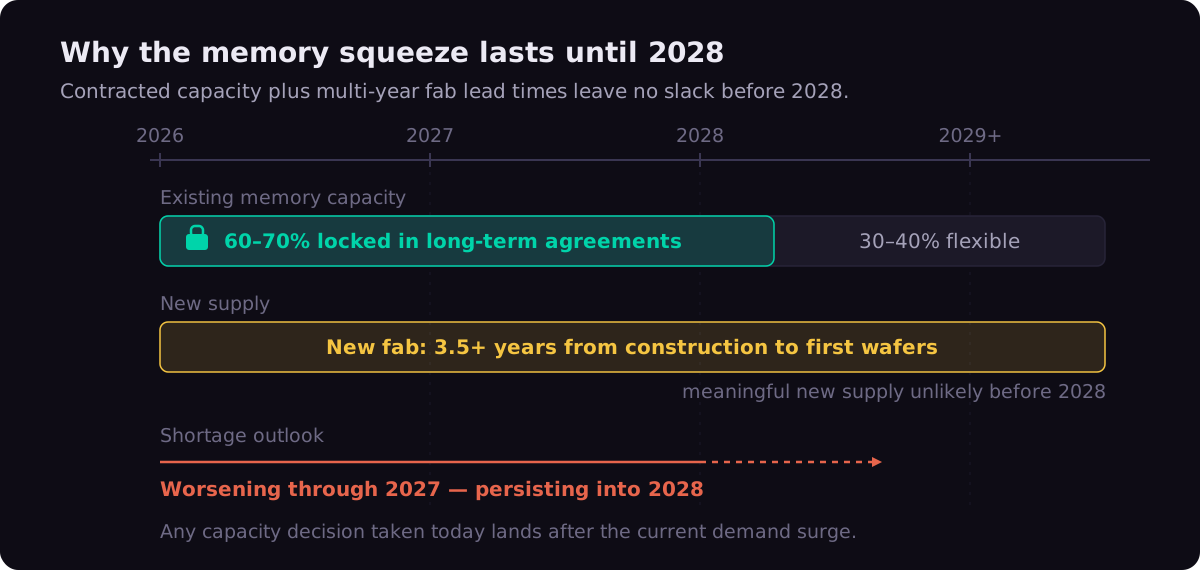
Explosive growth in agentic AI is generating unprecedented demand for memory and high-performance components. Leading manufacturers report that frontier model developers and hyperscalers are seeking multi-year long-term agreements (LTAs) to secure supply, expecting shortages to worsen through 2027 and persist into 2028.
The reason is construction schedules, not demand forecasting. A new fabrication facility requires more than three and a half years from construction to wafer output, making meaningful additional industry supply before 2028 unlikely regardless of the capital committed today.
Manufacturers are allocating 60 to 70 percent of capacity to firm LTAs, typically five-year rolling contracts with substantial advance payments, while retaining flexibility for the rest. In plain terms: most of the memory that will exist in 2028 already has a name on it.
Server SSDs are emerging as a major growth segment within NAND, projected to exceed 60 percent of revenue in some portfolios as agentic workloads expand key-value cache and inference storage requirements. Parallel demand is rising for ultra-high-capacitance MLCCs, FC-BGA substrates for AI accelerators, and silicon capacitors placed in close proximity to advanced packages.
For AI Factory operators
Memory is now a contracted input, not a spot purchase. If your 2027 plan assumes you can buy DRAM and enterprise SSDs when you need them at the price you modelled, that is its weakest line — and the planning discipline we bring to data centre engagements.
These shifts are steering the memory industry toward greater demand visibility and reduced cyclicality: a sector famous for boom-and-bust, reshaped by customers who will pay in advance for certainty.
Component suppliers expand capacity for AI infrastructure
Specialised component manufacturers are reporting robust order pipelines across AI-server and automotive applications. High-value multilayer ceramic capacitors (MLCCs) rated for ultra-high capacitance and elevated temperatures, together with FC-BGA substrates for next-generation AI chips, are experiencing tightening supply-demand balances.
The commercial response mirrors the memory market: long-term supply agreements with hyperscalers and semiconductor firms, plus accelerated capital expenditure on premium production — the pattern of an industry that reads this demand as structural, not cyclical.
Silicon-capacitor programmes are advancing in parallel, leveraging electrical characteristics complementary to MLCCs for placement nearest the AI dies, where power delivery is hardest. Camera-module lines are simultaneously ramping high-value automotive ADAS and humanoid-robot products, and outlook statements point to continued earnings strength through the remainder of 2026 and into 2027 as AI data-centre investment stays elevated.
The bottom line
Two of today’s stories are about capability arriving faster than expected: conversational voice at roughly 90 milliseconds and one-sixth the cost, and AI-search visibility an agent can diagnose and repair while you watch. The other three are about the substrate underneath, where every decision runs on a three-to-five-year clock.
That asymmetry is the theme worth carrying into planning. Software capability compounds monthly; memory, packaging and passive components compound over half a decade. The organisations still shipping in 2028 will be the ones that treated the second category with the seriousness they gave the first.
For operators in the region, the move is to secure the constrained inputs early and stay flexible on the model layer — which will only get cheaper. If you are building that plan for 2027, our team is happy to talk it through.